Range and Rhythm: Muay Thai Kicking Fundamentals

Power is often one of the first things people associate with Muay Thai kicks, but an effective kick requires much more than raw force. Range, timing, balance, footwork, hip rotation, and the ability to regain position all contribute to a well-executed technique. Developing these fundamentals takes consistent practice, which is why even experienced Muay Thai practitioners continue working on the same mechanics throughout their training.

Whether you are throwing a round kick for the first time or looking to make your combinations quicker and more effective, learning about range and rhythm is an important part of improving your striking. Even a powerful technique has limited value when it is used from the wrong distance or at the wrong moment.

Understanding Range

Every strike has a practical range where it can be used effectively. If you are too far away, your kick might fall short or lose its impact. If you are too close, you may not have enough space to perform the movement properly. Learning to recognize and manage distance is an essential part of Muay Thai.

Range is also always changing during an exchange. An opponent or training partner might step forward, move away, circle, change angles, or react to an earlier strike. Because of this, students are learning more than just how to kick. They are also developing the positioning needed to make the kick available.

Footwork is an important part of controlling that process. Moving into range without sacrificing balance, creating space when necessary, and maintaining a solid position after striking all help determine the next action. Through continued training, students develop a better sense of when they can attack and when they need to reposition themselves first.

muay thai lessons
Muay Thai clinch basics

The Teep: More Than a Push Kick

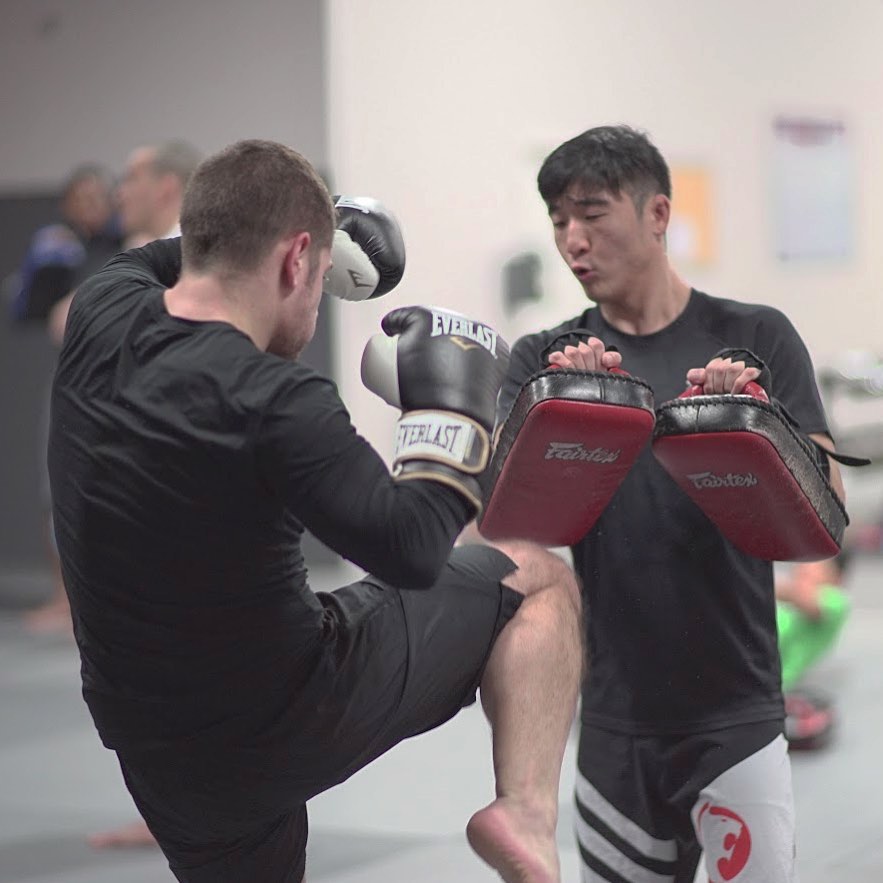
The teep is among Muay Thai’s most recognizable and adaptable techniques. It is sometimes compared to a jab because of its role in managing an exchange. A teep can control distance, interrupt forward pressure, disturb an opponent’s rhythm, and create openings for other attacks.

A properly timed teep involves more than pushing someone backward. Accuracy, balance, positioning, and timing all play a role in its effectiveness. The striker must also return quickly to a stable stance instead of finishing the movement off balance.

As students gain more experience, they begin to see how the teep fits into the larger striking system. It can be used to maintain distance, respond to an opponent’s movement, interrupt their timing, or prepare the next attack. While the technique may look straightforward, applying it successfully requires an understanding of both range and timing.

Developing a Strong Round Kick

The Muay Thai round kick is well known for its power, but effective power comes from coordinated movement rather than simply trying to swing the leg harder. The supporting foot, hip rotation, posture, balance, and timing all work together to create a strong kick.

Learning the movement’s mechanics is only the beginning. Students must also understand how and when to use the round kick during an exchange. It can be thrown independently, combined with punches, included in longer combinations, or timed around an opponent’s movement. The setup often matters just as much as the kick itself.

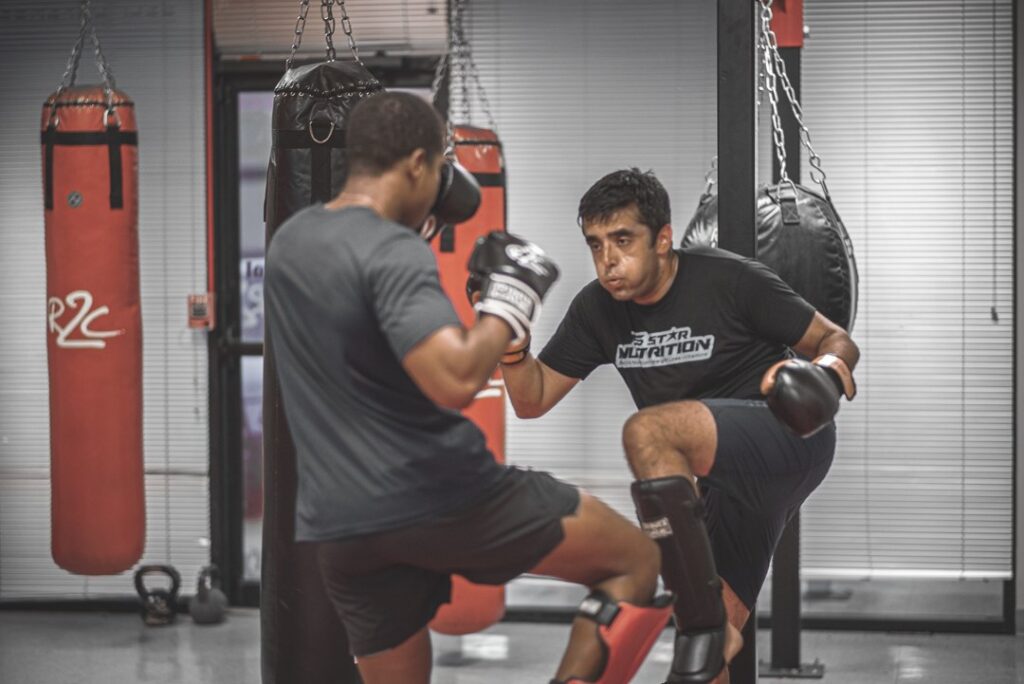
Practicing on pads, heavy bags, and through partner drills gives students the opportunity to refine their technique while improving accuracy, speed, and control. With repetition, movements that once required conscious attention begin to feel more natural. Students can then focus less on each individual part and more on how and when to apply the technique.

Finding Rhythm Without Becoming Predictable

Rhythm in Muay Thai is not about maintaining one consistent pace throughout a round. In fact, predictable movement can make attacks easier to anticipate. Developing rhythm involves becoming comfortable with movement, identifying openings, and recognizing when to attack, defend, reset, or change speed.

Combinations play an important role in developing this skill. Punches can open opportunities for kicks, a teep can interrupt an opponent before another strike, and changes in timing can make familiar techniques harder to predict. As students become more confident with individual strikes, they learn how to connect techniques instead of treating every punch or kick as an isolated movement.

Partner drills and controlled live training add another level of difficulty because the person in front of you is constantly responding. Distance shifts, openings disappear, and techniques must be adjusted. Students learn to react to the situation rather than relying only on a fixed sequence of movements.

When the distance closes entirely, another part of Muay Thai becomes important. Our earlier guide to Muay Thai Clinch Basics  explores the transition from kicking and striking range into the clinch.

Technique Before Power

Wanting to develop stronger kicks is a natural part of Muay Thai training. However, power becomes more useful when it is supported by proper technique and control.

Students who understand balance, timing, range, and positioning have a stronger foundation for developing speed and power without losing control. These fundamentals also support faster recovery after a strike, smoother combinations, better defense against counters, and the ability to change position when necessary.

This is one reason fundamental techniques remain important regardless of experience level. The round kick continues to matter even after years of training, while the teep is not simply a technique for beginners. As students progress in Muay Thai, they continue discovering new details and applications within these foundational movements.

Kicking is only one part of Muay Thai’s broader striking system. Our guide to Muay Thai strategy and the art of the eight limbs  takes a closer look at how punches, kicks, elbows, and knees work together.

Putting It Together on the Mats

Range, rhythm, timing, and technique work together throughout every part of Muay Thai training. These elements influence how students move into position, throw combinations, respond to training partners, and recover after an exchange.

For beginners, the process may involve becoming comfortable with their stance, footwork, teep, and round kick mechanics. More experienced students might focus on improving their timing, disguising attacks, changing their rhythm, developing combinations, or making small adjustments that improve their overall striking.

This continuous progression is part of what makes Muay Thai both challenging and rewarding. There is always another technical detail to refine, another combination to practice, and another opportunity to improve how techniques are used against someone who is moving and reacting in real time.

At Ground Control Stuart, Muay Thai Kickboxing  gives students the opportunity to build these skills through consistent training, starting with a strong foundation in striking fundamentals. Whether you are stepping onto the mats for the first time or have practiced countless round kicks, there is always another aspect of your technique to develop.

Don’t Stop Here

More To Explore

Join Us

Try A Class
For Free